Skip to content

Built for pharmaceutical data and AI leaders

The data-readiness platform for enterprise AI

Know which AI use cases your data can support.

DATA Compass evaluates the data behind a declared use case and returns a defensible result, the evidence-backed blockers, an owned remediation path, and a basis for reassessment—without moving connected source data.

AI readiness, measured—not asserted.

Read-only assessment · Runs inside your environment · Connected source data is not moved

Decision Brief Verified Synthetic Sample

Dataset Quality Events Dataset Product 2.5.0 Rubric 1.2.0

  1. Declared use Supervised AI
  2. Recorded result 50/ 100current readiness
    • 7 of 16 FAIR rules passed
    • 4 of 18 columns mapped
    • Data cleanliness 45 / 100
  3. Primary blocker Cross-system semantic and metadata fragmentation
  4. First recommended move Recommended Review high-confidence ontology mappings Human control: review, accept, edit, or reject the recommended action.
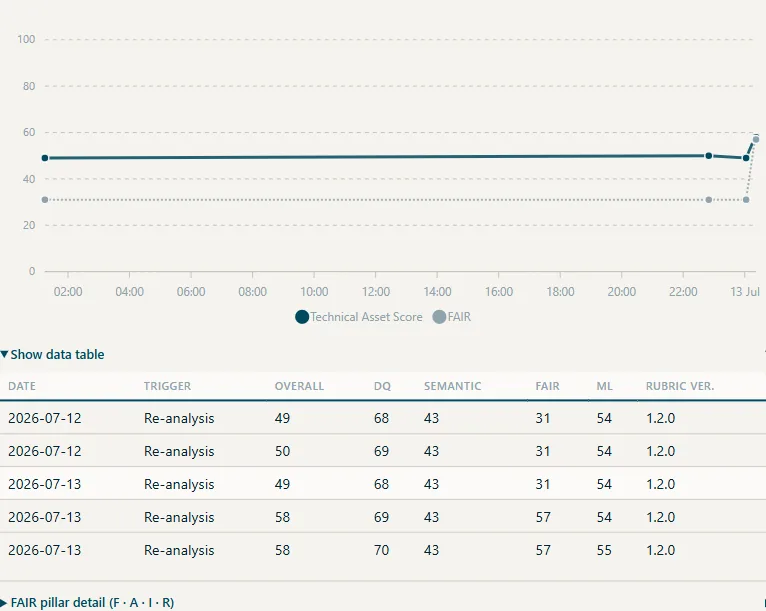
  5. Reassessment Overall readiness 50 to 58 FAIR foundation 31 to 57

Synthetic sample · Values recorded from DATA Compass product output
Use-specific assessment

Versioned rules and cited evidence

Human-reviewed remediation

Read-only, in your environment

The Decision

Turn a data-quality debate into an owned next move.

A general data-quality score does not answer whether data is fit for a particular AI-assisted decision. Fitness depends on the decision being made—so one score leaves three teams reading it three different ways.

  1. Advance too early

    An AI workflow reaches users before its data limitations are understood or defensible.

  2. Fix everything

    Scarce data teams remediate broadly without knowing which changes affect the declared use.

  3. Keep debating

    The pilot stalls because business, data, governance, and Quality teams lack one evidence base.

DATA Compass gives those teams a shared basis to advance, remediate, or defer.

The Output

A decision brief leaders can use.

Each assessment ties a declared use to the evidence, blocking conditions, recommended actions, human decisions, and the next reassessment point.

Decision Brief Verified Synthetic Sample

Dataset Quality Events Dataset Product 2.5.0 Rubric 1.2.0

Every row below is recorded evidence. The row marked Recommended is an action a person decides.

  1. Declared use Supervised AI
  2. Recorded result 50/ 100current readiness
  3. Primary blocker Cross-system semantic and metadata fragmentation
    Evidence recorded for the primary blocker
    FAIR rules passed7 of 16
    Columns mapped to ontology4 of 18
    Data cleanliness45 / 100
  4. First recommended move Recommended Review high-confidence ontology mappings Human control: review, accept, edit, or reject the recommended action. DATA Compass does not change the data.
  5. Reassessment
    Measured change on reassessment
    MeasureBeforeAfter
    Overall readiness5058
    FAIR foundation3157

Synthetic sample · Values recorded from DATA Compass product output
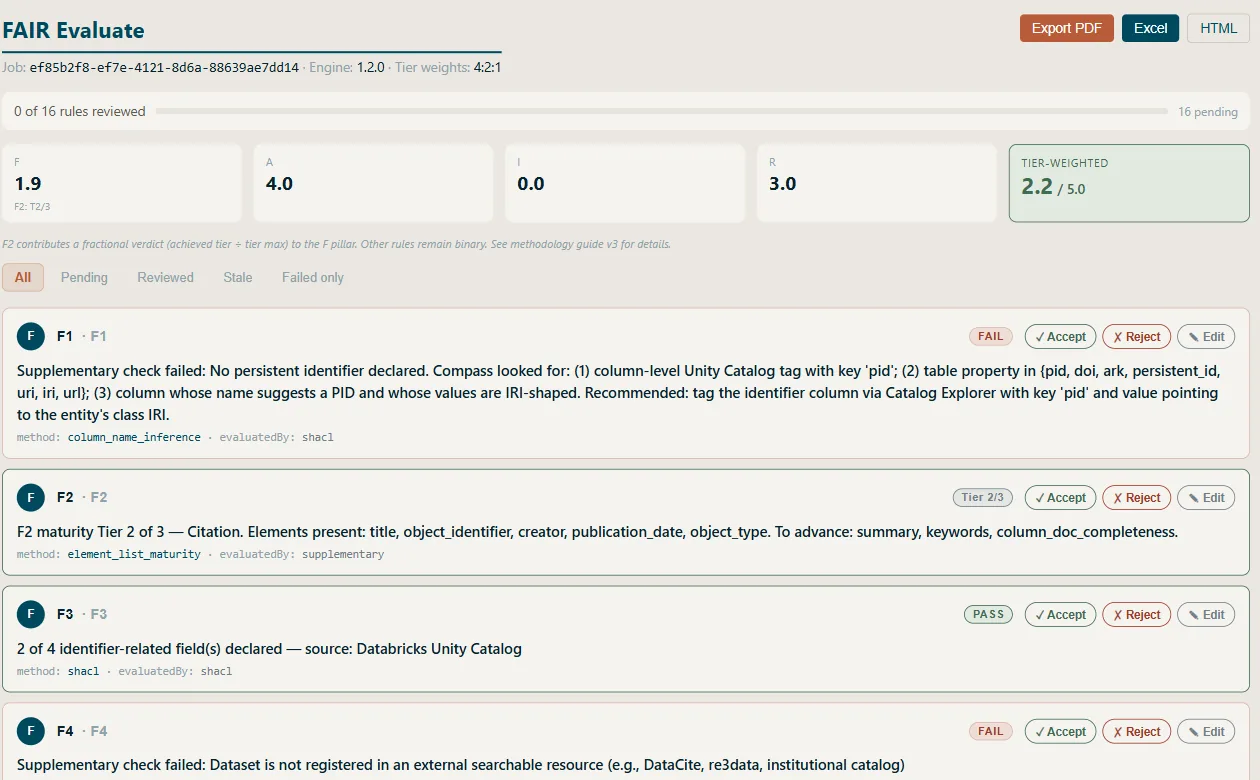
DATA Compass FAIR Evaluate view for the sample dataset: rule-by-rule verdicts with the interoperability pillar at zero, each verdict showing its supporting evidence and review controls.
Product view · Synthetic sample. Every rule verdict carries the evidence it was decided on. Open full size.

Readiness is judged against the declared use—not in the abstract.

The same dataset can be ready for one decision and unfit for another. A cohort-summary report and a supervised clinical copilot draw on the same records but carry different tolerances for missing values, semantic precision, provenance, and oversight.

DATA Compass therefore assesses against a use you declare, and the result is legible only in that context. Change the declared use and the same evidence is re-read against different expectations.

How It Works

From evidence to an owned next move.

  1. Assess

    Declare the use and measure semantic clarity, statistical health, contextual validity, and regulatory compliance.

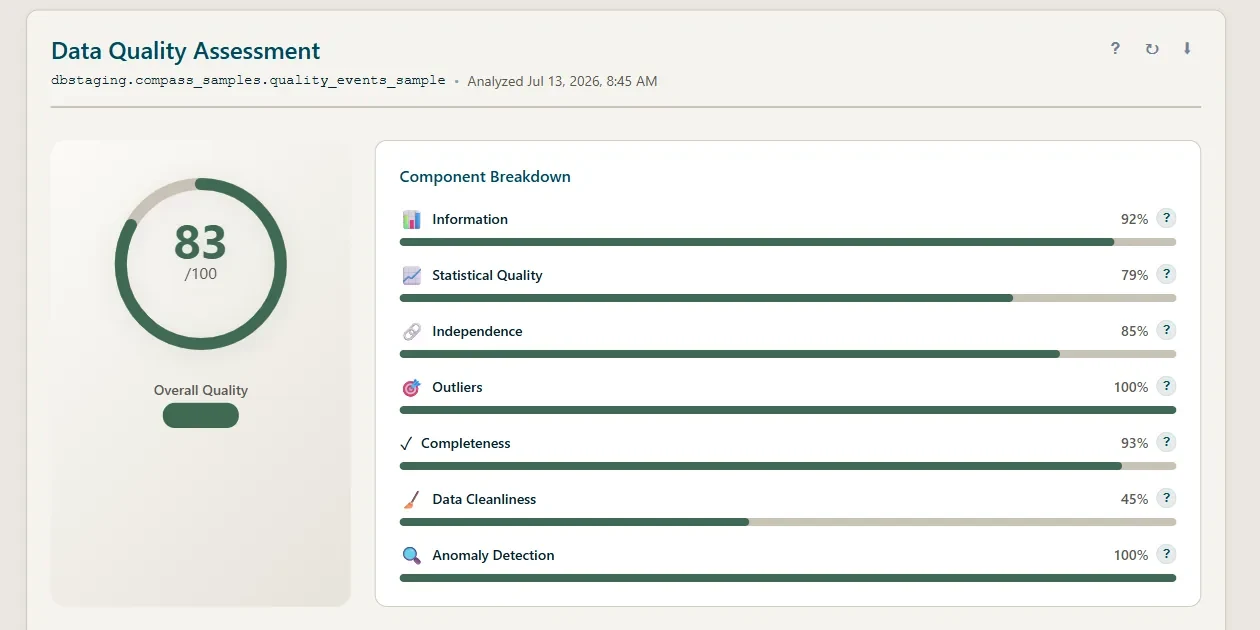
    DATA Compass data-quality assessment for the sample dataset: an overall score beside a seven-component breakdown, with data cleanliness at 45 percent as the weak component.
    Synthetic sample · Assess
  2. Diagnose

    Trace blocking findings to the rule, evidence, source, and assessment version.

    DATA Compass rule-by-rule FAIR verdicts for the sample dataset, each finding linked to the evidence behind it.
    Synthetic sample · Diagnose
  3. Act

    Prioritize remediation and keep the decision with accountable people.

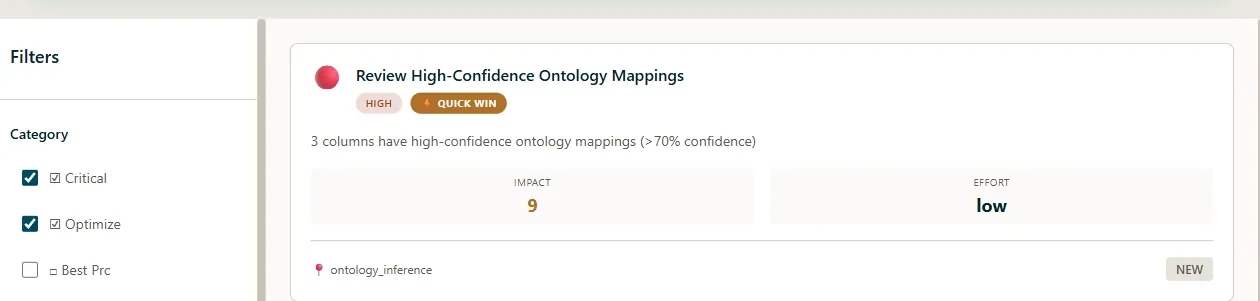
    A DATA Compass recommendation card for the sample dataset — review high-confidence ontology mappings — carrying its impact and effort ratings for prioritization.
    Synthetic sample · Act
  4. Prove

    Reassess against the same basis and show what changed—and what did not.

    DATA Compass readiness trajectory for the sample dataset, plotting the overall and FAIR scores across successive remediation readings with the underlying data table.
    Synthetic sample · Prove

83/ 100 Data quality

is not the same as

50/ 100 Readiness for supervised AI

Clean data can still be unfit for the decision.

Quality asks whether the records are sound. Readiness asks whether they can carry a particular decision—which also depends on meaning, use context, governance, provenance, and the regulatory expectations that apply.

Both values recorded from the same synthetic sample assessment.

Why It Is Defensible

Versioned rules decide. AI explains.

Every verdict is produced by a versioned rule against cited evidence. Language models narrate the result; they do not determine it. Three independent reads are held side by side.

  • Technical

    What the data shows.

  • Perceived

    What people experience.

  • Governed

    What the approved documents say.

Example diagnostic pattern

Usability Gap

Technical high Perceived low Governed high

Meaning
The data and governance evidence appear strong, but the people who depend on the data cannot use it productively.
First move
Examine discoverability, training, UX, and the path from the catalog entry to the practitioner.

An illustrative pattern from the diagnostic library—not a customer finding, and not drawn from the sample above.

Common Declared Uses

Built for the decisions pharma teams are already trying to make.

Medical and regulatory evidence copilot

The decision
Whether to put a bounded, supervised copilot in front of medical and regulatory staff.
The readiness question
Can controlled scientific and regulatory content support a bounded, supervised copilot?

Quality investigation and deviation triage

The decision
Whether to let AI assist triage inside a regulated quality process.
The readiness question
Can quality-event data support AI-assisted investigation without weakening traceability or defensibility?

Commercial next-best action

The decision
Whether to route field and channel effort using a model recommendation.
The readiness question
Can CRM, prescribing, channel, and HCP identity data support a recommendation leaders should act on?

Deployment

Your data stays. DATA Compass comes to it.

  • Runs inside the customer environment
  • Assesses connected sources in read-only mode
  • Does not require source-data movement
  • Preserves evidence and assessment provenance

Connects to

  • Databricks
  • Snowflake
  • Veeva Vault
  • Stardog

Plus customer-provided files and a REST API. Customer-provided files stay inside your deployment boundary.

Bring one priority AI use case.

See how DATA Compass turns data-readiness evidence into a blocker, an owned remediation path, and a basis for reassessment.

Explore all industries