AI readiness,
measured—not asserted.
Know whether your data can support a defined AI use case, what is blocking it, what to fix first, and what the fix is worth—without moving connected source data.
Built for regulated industries · Source data stays in your environment · Read-only, in place
What evidence says your AI program is ready to scale?
A promising model is not a production system. Scaling depends on an explicit use case, fit-for-purpose data, workflow integration, accountable ownership, feedback and learning, and measurable business outcomes.
No single checkpoint guarantees success. The evidence has to hold across the system.
-
01 · Defined use
The business outcome, decision, workflow, and intended level of autonomy are explicit.
-
02 · Data readiness
The data is semantically clear, statistically sound, contextually valid, and assessed against applicable regulatory and data-integrity expectations for the declared use.
- Semantic clarity
- Statistical health
- Contextual validity
- Regulatory compliance
-
03 · Workflow fit
The system operates where the work happens rather than beside the workflow.
-
04 · Ownership
Business, operational, and technical accountability are clear.
-
05 · Learning
Feedback and changing context improve the system over time.
-
06 · Business outcome
Operational value is measured after deployment.
AI success is a system. Data readiness is a critical gate.
DATA Compass makes that gate measurable—and reassesses it to prove the lift.
Data quality is not data readiness
for supervised AI
- Semantic ambiguity
- Statistical risk
- Contextual mismatch
- Regulatory exposure
The gap is the work.
A dataset can pass conventional quality checks and still be unsuitable, ambiguous, contextually invalid, or non-compliant for a defined AI use case.
Illustrative sample datasetMeasurement becomes direction.
Every finding resolves into evidence, a recommended next move, and a measurable reassessment target. Every screen and every number below is the product on one illustrative sample dataset — recorded, not mocked.
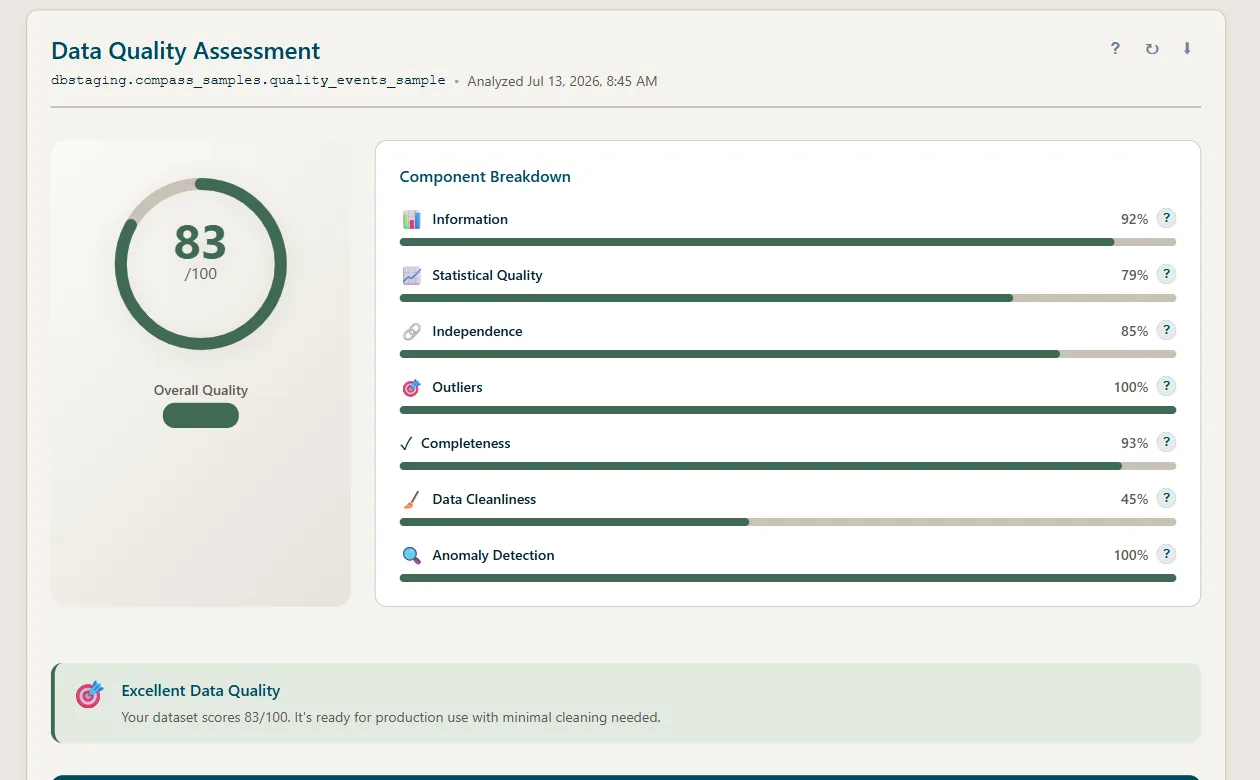
Clean data is not ready data.
83 data quality · 50 data readiness for supervised AI
Data quality scores 83/100—yet technical data readiness for supervised AI is 50, because semantic, FAIR-foundation, and ML-readiness gaps remain. The gap between those two numbers is the argument.
The gaps, named and evidenced.
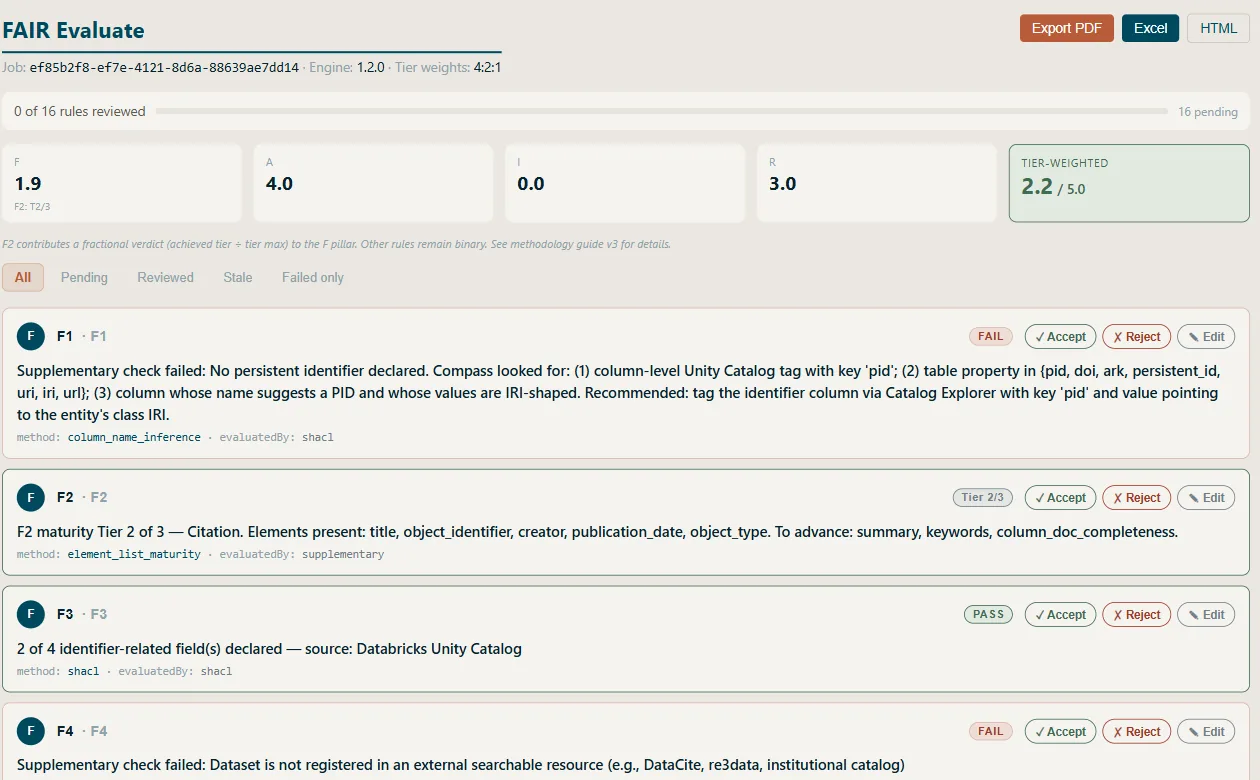
Cross-system semantic and metadata fragmentation
11 event-type variants · 3 severity scales · 4 of 18 columns mapped
Every failed check carries its evidence: the interoperability pillar at zero, no machine-readable identifiers or vocabulary bindings — the fragmentation made visible, rule by rule, with review controls on each verdict.
The fix arrives with the finding.
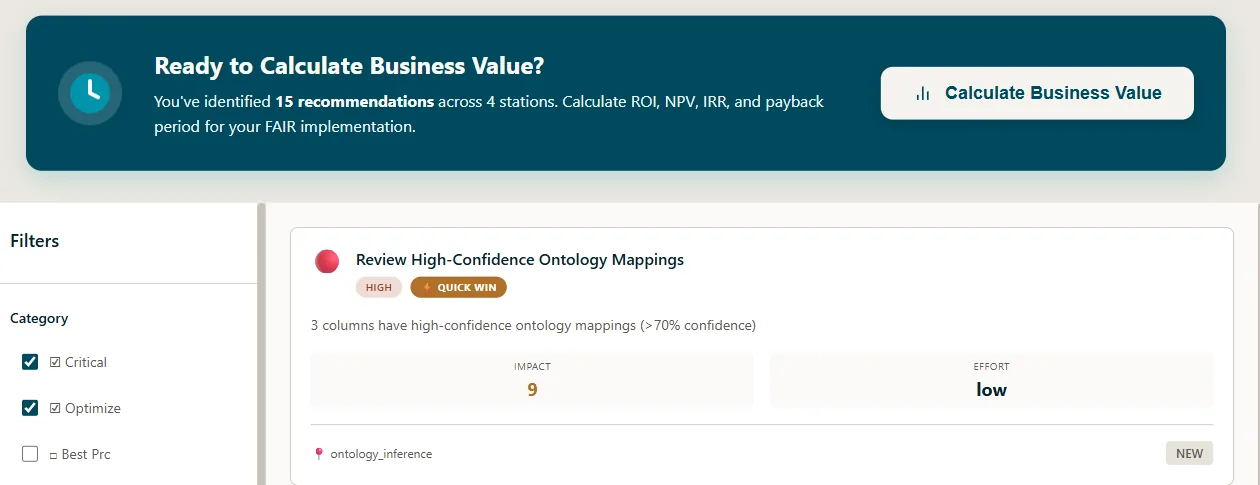
Establish a governed semantic foundation across source systems.
Recommendations arrive ranked, with impact and effort attached — and a business-value calculation offered across the full set, so the first thing you do is the thing that moves readiness most.
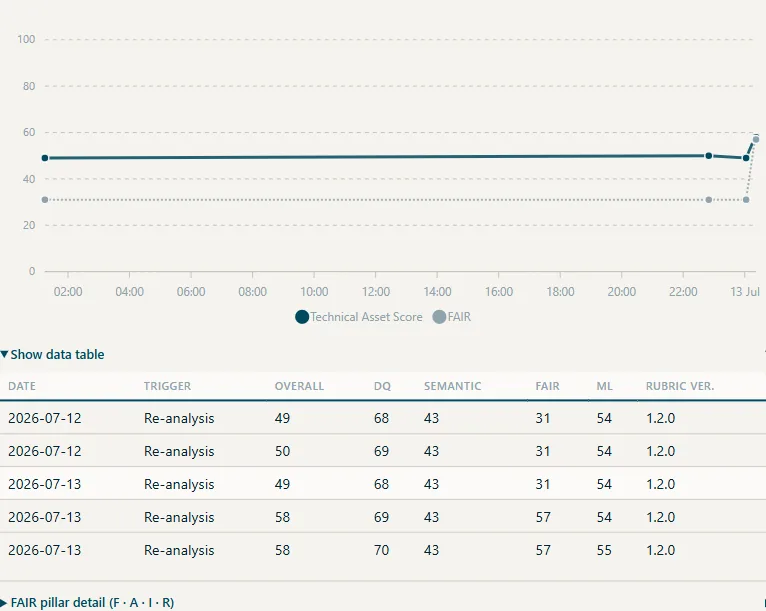
Reassessed. The trajectory is the deliverable.
50 → 58 overall · FAIR 31 → 57 · 150 duplicate records removed
Every re-analysis appends a reading: the score trend per dimension and the delta since your last checkpoint — the readiness lift measured, the business value modeled from your assumptions.
Four dimensions. One foundation.
FAIR makes data legible — findable, accessible, interoperable, reusable. Necessary, and not sufficient: a perfectly FAIR dataset can still be statistically broken, wrong for your use, or non-compliant. Compass treats FAIR as the substrate and measures the four dimensions it enables but cannot guarantee.
Semantic Clarity
Does the data mean what it says — to a machine?
Proof · ontology inference with labelled confidence
- Infer column-to-class alignment before it's tagged
- Score against your private ontologies — CDISC, IDMP, your taxonomy
- Interoperability made first-class: declared, inferred, or absent
Statistical Health
Is the data quantitatively sound?
Proof · every score traces to a named test
- Data quality — eight component algorithms
- ML readiness — sufficiency, bias, separability, features
- Named tests: Benford, Pearson, Cohen's Kappa, Shapley
Contextual Validity
Is the data right for your specific use?
Proof · evidence-cited judgment per rule
- Customer-authoritative Domain Packs, versioned and yours
- Fit scored against a declared use
- Deterministic rules first, synthesis only where it must be
Regulatory Compliance
Does the data meet the integrity bar?
Proof · readiness against regulatory expectations — advisory, not certification
- ALCOA+ — nine data-integrity attributes
- FDA credibility — seven steps plus Step 8
- GDPR · HIPAA · CCPA, cited line-by-line
Three reads on one domain.
The disagreement is the finding.
Compass doesn't take the data's word for it. Every FAIR assessment triangulates three independent reads. Where they agree, you have a finding you can defend. Where they diverge, the divergence itself is the insight — and it's named, not hand-waved.
Eight canonical patterns turn the relationship among Technical, Perceived, and Governed evidence into a shared diagnostic language. Explore a pattern to see what it means and where to look next.
- Technical
- Perceived
- Governed
01 Confirmed Maturity Technical High · Perceived High · Governed High
What it means. The data, stakeholder experience, and governance evidence all agree that the domain is strong.
First move. Preserve and propagate. Protect the practices from regression and reuse the controls, artifacts, and working methods that make the domain successful.
02 Aligned Maturity (suspected) Technical High · Perceived High · Governed Not yet gathered
What it means. Technical evidence and stakeholder experience agree on high maturity, but governance evidence has not yet been reviewed.
First move. Review the governance documents. Determine whether the pattern resolves to Confirmed Maturity or Unformalized Practice.
03 Greenfield Technical Low · Perceived Low · Governed Low or deliberately absent
What it means. All available signals agree that the domain is early-stage. This is an investment decision, not necessarily a remediation problem.
First move. Decide whether to invest or accept the current state. Do not treat every Greenfield domain as broken.
04 Usability Gap Technical High · Perceived Low · Governed High
What it means. The data and governance evidence appear strong, but the people who depend on the data cannot use it productively.
First move. Examine discoverability, training, UX, and the path from the catalog entry to the practitioner.
05 Tribal Knowledge Technical Low · Perceived High · Governed Deliberately absent
What it means. The domain works because a small number of people know its quirks, while metadata and formal governance remain thin or deliberately absent.
First move. Capture the practice. Externalize the knowledge while the subject-matter experts are still available.
06 Unformalized Practice Technical High · Perceived High · Governed Low
What it means. The data is strong and the team operates effectively, but the working method has not been formally documented.
First move. Codify what already works. Write the SOP around the real operating practice rather than replacing it with a generic template.
07 Abandoned Capability Technical High · Perceived Low · Governed Deliberately absent
What it means. A technically sound asset remains, but it has lost users, ownership, and governing practice.
First move. Make a decision. Reinvest around a current use case or formally retire the capability.
08 Policy Theater Technical Low · Perceived Low · Governed High
What it means. Governance documentation describes a mature system that the data and operating experience do not support.
First move. Audit practice against policy. Reconcile the documented state with operational reality.
Patterns are diagnostic, not directive. Recommended first moves are starting points for discussion with the people who run the domain.
Your data stays. Compass comes to it.
Compass deploys inside your environment and connects to your platforms read-only. Analyses run through your own compute. Connected source data stays in the systems that own it—no ETL and no copies out. When you provide a file, that authorized copy is processed inside your deployment boundary.
No connected source data crosses this boundary without your approval.
How much autonomy can your data support?
Higher autonomy raises the evidence bar.
Connect your data where it lives.
Connected sources are assessed read-only and in place. Customer-provided files stay inside your deployment boundary.
Databricks
Unity Catalog browser, SQL profiling, MLflow assessment.
Snowflake
Database and schema browser with SQL API profiling.
Veeva Vault
QMS, CDMS, and RIM module adapters with OAuth2 SSO.
Stardog
SPARQL querying, ICV validation, reasoning-powered analysis.
Know before you deploy.Measure data readiness. Ship AI on evidence.
Start with a technical data-readiness assessment in minutes. No code changes, no movement of connected source data, no black boxes.
We'll walk you through a technical data-readiness assessment on an illustrative dataset—read-only, in place.